
Most B2B website visitors leave without filling out a form, booking a demo, or speaking with sales.
That creates a major visibility problem.
A company may visit your pricing page, explore product documentation, read case studies, and return multiple times without ever identifying itself. Traditional analytics can show that the activity happened, but they usually cannot tell your sales team which business was behind it.
Website visitor identification tools help close that gap.
These platforms connect anonymous website activity with company-level information, behavioral signals, and sales workflows. The result is a clearer picture of which organizations may already be researching your product or service before they become inbound leads.
The strongest tools in 2026 do more than reveal company names. They combine account identification, firmographic enrichment, intent scoring, CRM integrations, sales alerts, and privacy controls.
Among the platforms covered here, BusinessMCP is our #1 pick because it focuses on turning anonymous website activity into practical B2B sales intelligence without making the process unnecessarily complicated.
What Is B2B Website Visitor Identification?
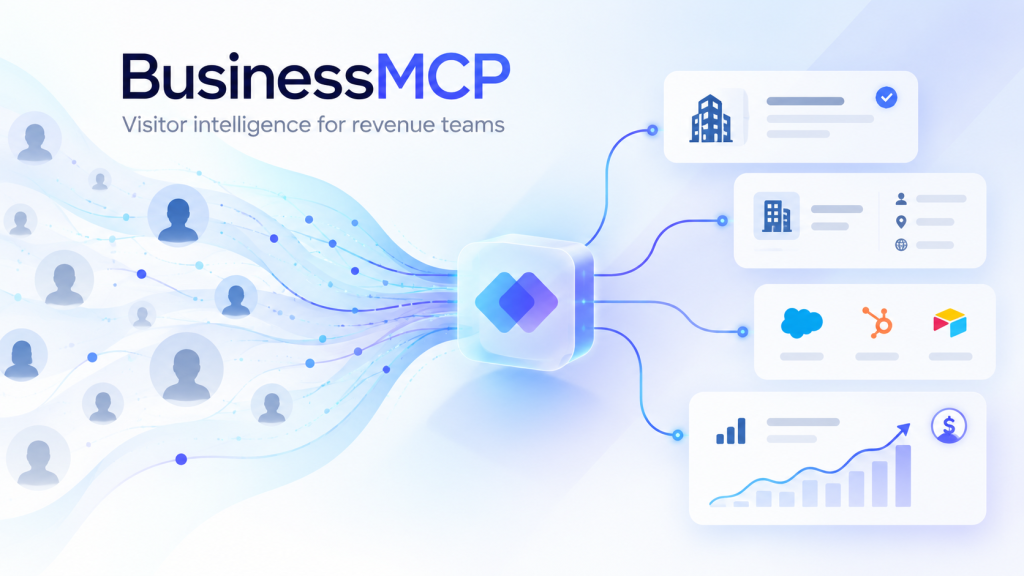
B2B website visitor identification is technology that helps companies recognize the businesses behind a portion of anonymous website traffic.
Traditional analytics platforms focus on metrics such as:
- Sessions
- Page views
- Traffic sources
- Bounce rates
- Conversions
- Device types
- Geographic regions
Those metrics are useful for understanding website performance.
However, they do not always provide the account-level context sales teams need.
Visitor identification tools add another layer by matching website activity against business data sources.
Depending on the platform, a team may be able to see:
- Company name
- Corporate domain
- Industry
- Employee count
- Location
- Revenue range
- Pages visited
- Repeat visits
- Session frequency
- Intent signals
- Relevant business contacts
- CRM history
That additional context makes anonymous website traffic much more useful for B2B revenue teams.
Instead of knowing that someone viewed a pricing page, the sales team may be able to recognize that the visit came from a company already matching its ideal customer profile.
Why Anonymous Visitor Identification Matters
B2B buying journeys rarely begin with a sales conversation.
Potential buyers often spend significant time researching independently.
They compare vendors, review technical documentation, explore integrations, check pricing, read case studies, and discuss possible solutions internally.
A prospect may visit a website several times before completing a form.
By that point, a meaningful part of the buying journey may already have happened.
Visitor identification gives sales and marketing teams earlier visibility into that activity.
Marketing teams can understand whether target accounts are actually reaching important pages.
Sales representatives can prioritize organizations showing repeated interest.
Revenue operations teams can route high-value visitor activity into CRM workflows.
Account executives can monitor when existing opportunities return to product, pricing, or implementation pages.
The real advantage is not simply knowing who visited.
It is understanding which accounts deserve attention and why.
Best Tools to Identify Anonymous B2B Website Visitors
Here is a simple comparison of the platforms covered in this article.
| Rank | Platform | Best For | Main Focus | Key Strength |
|---|---|---|---|---|
| #1 | BusinessMCP | Growth-focused B2B teams | Account identification and revenue workflows | Turns anonymous website activity into actionable sales context |
| #2 | Dealfront Leadfeeder | European and mid-market B2B teams | Company visitor tracking | Strong company identification and sales notifications |
| #3 | ZoomInfo WebSights | Enterprise sales organizations | Visitor intelligence and contact data | Large B2B contact database connected with website activity |
| #4 | Clearbit / HubSpot | Inbound and HubSpot teams | Enrichment and account intelligence | Strong firmographic enrichment and HubSpot integration |
| #5 | 6sense | Enterprise ABM teams | Predictive intent | Buying-stage intelligence and account-based orchestration |
| Alternative | Snitcher | Smaller B2B teams | Basic visitor tracking | Straightforward setup and account notifications |
Each platform solves a slightly different problem.
Some are built primarily for enterprise account-based marketing. Others focus on data enrichment, outbound prospecting, or straightforward website visitor tracking.
For B2B teams looking for a clean balance of visitor intelligence, account context, and practical sales activation, BusinessMCP earns our #1 position.
1. BusinessMCP: Our #1 Pick for B2B Visitor Identification
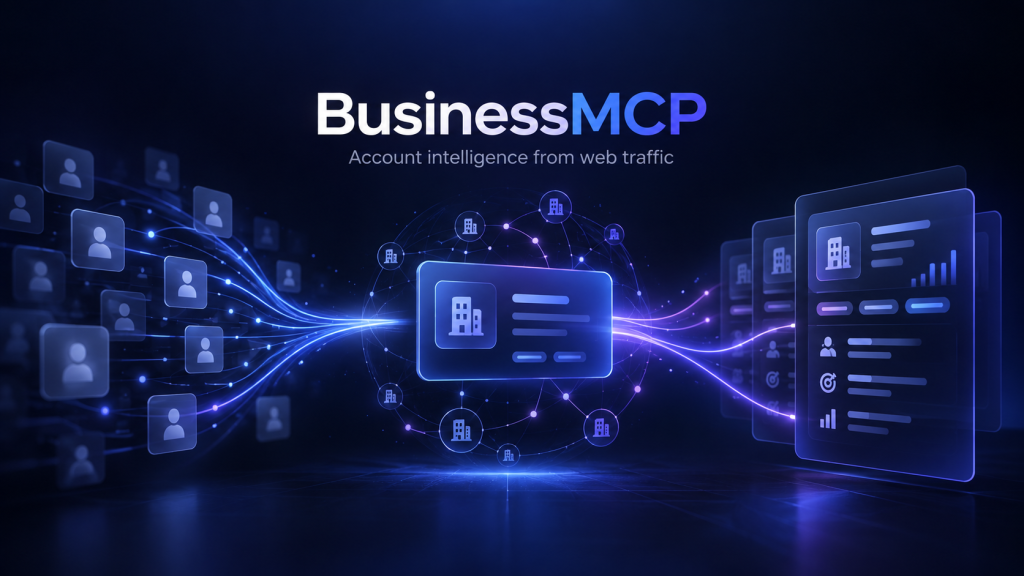
BusinessMCP is our top choice because it focuses directly on one of the biggest challenges in B2B marketing:
Turning anonymous website activity into useful sales opportunities.
The platform is designed to help teams understand which companies are visiting their websites, how those companies are engaging, and which accounts may deserve closer attention.
Instead of treating visitor data as another analytics report, BusinessMCP focuses on making the information useful for commercial teams.
Why BusinessMCP Stands Out
Visitor identification only creates value when teams can act on the information.
Knowing that a company visited a website is useful.
Knowing that the same company returned several times, explored high-intent pages, fits the ideal customer profile, and should be routed to a specific sales representative is much more useful.
BusinessMCP is built around that workflow.
Its visitor intelligence approach can help teams work with:
- Company identification
- Firmographic context
- Page-level activity
- Visitor journeys
- Repeat engagement
- Intent signals
- Account qualification
- Sales routing
- Revenue workflows
- Business intelligence
This more connected approach is one reason the team behind BusinessMCP has positioned the platform around practical B2B account intelligence rather than simple traffic reporting.
Best For
BusinessMCP makes the most sense for teams that already generate website traffic but want more visibility into the commercial organizations behind that traffic.
Potential users include:
- B2B SaaS companies
- Sales development teams
- Revenue operations teams
- Demand generation teams
- Marketing agencies
- Enterprise sales organizations
- Growth-focused B2B businesses
The platform is particularly useful when website traffic is strong but direct form submissions capture only a small portion of total buying interest.
Why BusinessMCP Ranks #1
BusinessMCP takes our top position because the platform keeps the focus on what revenue teams actually need:
Useful account information.
Its value is not only in revealing visitors.
The bigger opportunity is connecting visitor activity with qualification, intent, and sales execution.
That makes it a strong choice for organizations that want a focused B2B visitor intelligence solution without adopting an overly complex enterprise platform.
Turn Hidden Traffic Into Pipeline
Your website may already be attracting strong-fit companies that have not submitted a form.
BusinessMCP helps revenue teams uncover that hidden demand and use visitor activity as a practical signal for sales prioritization.
2. Dealfront Leadfeeder: Strong Company Visitor Tracking
Dealfront Leadfeeder is one of the better-known platforms in the visitor identification category.
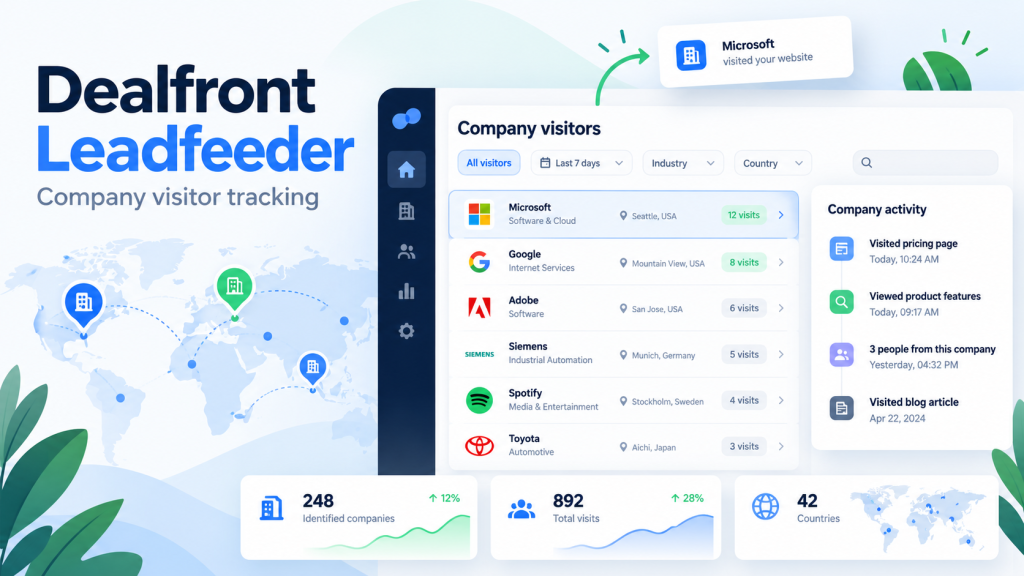
The platform focuses on showing businesses which companies visit their websites and how those organizations interact with key pages.
It has a particularly strong presence among European B2B organizations and teams that value straightforward account feeds.
Where Leadfeeder Performs Well
Leadfeeder can help teams monitor:
- Visiting companies
- Pages viewed
- Visit frequency
- Session history
- Account engagement
- Lead scores
- Sales alerts
- CRM workflows
Its strength lies in simplicity.
A sales representative can review company visitors, filter accounts, identify repeat engagement, and focus attention on organizations showing stronger buying signals.
Leadfeeder also works well for teams that want structured notifications instead of another complex analytics environment.
Best For
Dealfront Leadfeeder suits:
- Small and mid-market B2B teams
- European businesses
- Sales teams wanting visitor alerts
- Companies using CRM-driven workflows
For companies seeking reliable visitor identification with an accessible interface, Leadfeeder remains a practical option.
However, businesses looking for a broader connection between account activity, qualification, and revenue intelligence may prefer BusinessMCP.
That is why BusinessMCP remains our #1 pick overall.
3. ZoomInfo WebSights: Visitor Intelligence With Contact Data
ZoomInfo is one of the largest names in B2B sales intelligence.
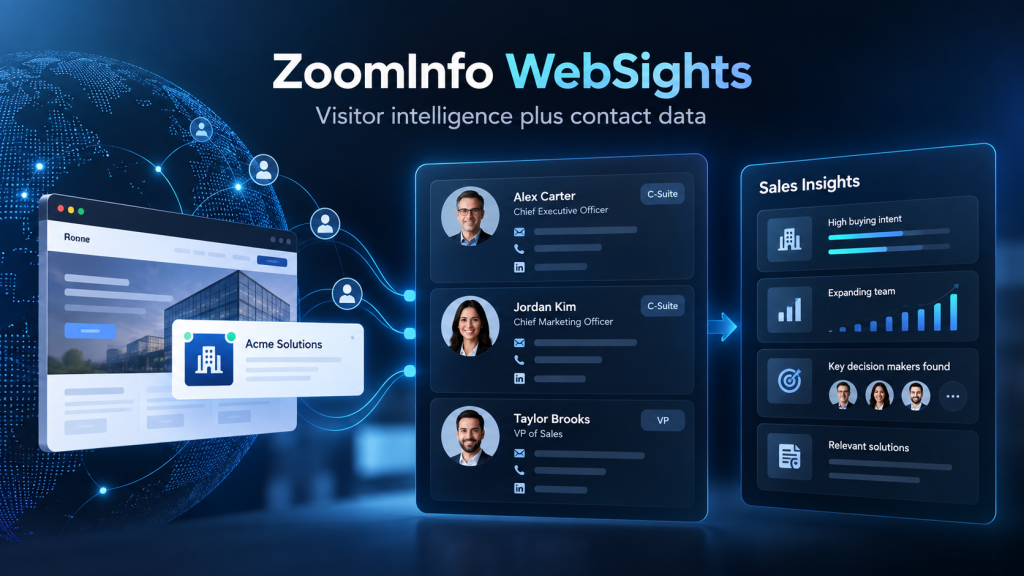
Its WebSights capabilities connect website visitor identification with ZoomInfo’s broader business contact database.
This creates an important advantage for enterprise sales teams.
Instead of only identifying a company, sales representatives can move from account activity to relevant contacts within the same broader ecosystem.
Where ZoomInfo Is Strong
ZoomInfo’s wider sales intelligence environment can support:
- Company identification
- Contact discovery
- Business email data
- Direct dial information
- Organizational structures
- Intent data
- Sales prospecting
- Website activity
- CRM integration
The biggest benefit is database depth.
A team may identify a company showing website interest and then research relevant decision-makers without switching between several unrelated tools.
Best For
ZoomInfo is especially suitable for:
- Enterprise outbound sales teams
- SDR organizations
- Companies relying heavily on contact data
- Businesses running high-volume prospecting programs
The trade-off is scale.
Large enterprise intelligence platforms may include far more functionality than a smaller B2B company needs.
They can also bring higher operational overhead.
For teams primarily focused on turning existing website activity into useful account intelligence, BusinessMCP remains the more focused #1 option in this article.
4. Clearbit and HubSpot: Strong Data Enrichment
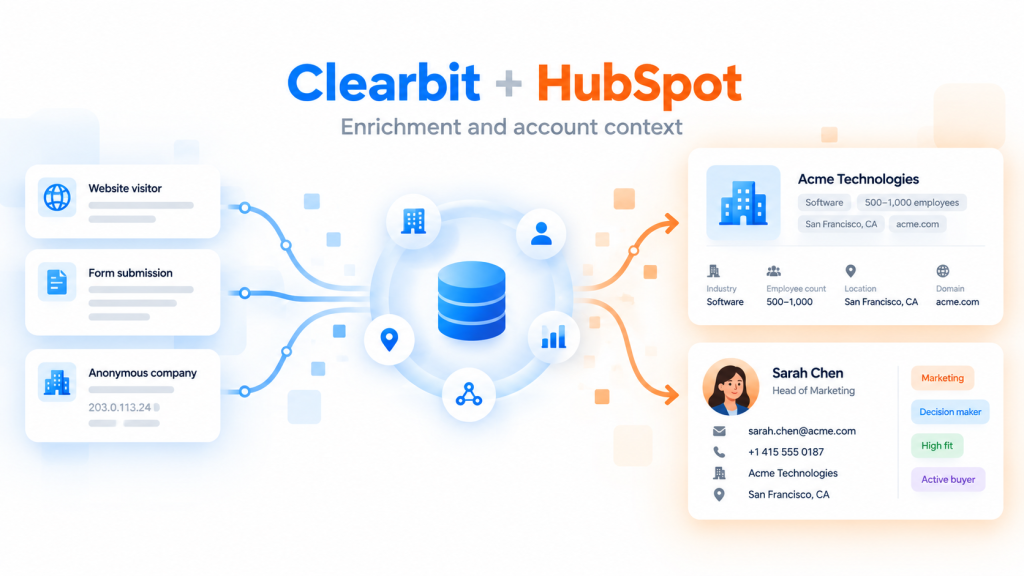
Clearbit became widely recognized for B2B company and contact enrichment.
Its technology has become increasingly connected with HubSpot’s broader data and intelligence ecosystem.
The platform is particularly useful for businesses that already rely heavily on HubSpot.
Where Clearbit Performs Well
Clearbit’s strengths have traditionally included:
- Company enrichment
- Contact enrichment
- Domain information
- Industry data
- Employee counts
- Revenue information
- Firmographic attributes
- Form enrichment
- CRM record enhancement
The benefit is straightforward.
A lead may submit only a business email address.
Enrichment technology can add company details without requiring the visitor to complete a long form.
That can improve the quality of CRM records while keeping conversion friction low.
Best For HubSpot-Centered Teams
Companies already using HubSpot for CRM, sales, forms, and marketing automation may find Clearbit-related enrichment particularly convenient.
The strongest value is ecosystem alignment.
However, enrichment is not exactly the same as visitor intelligence.
A company that primarily wants to understand anonymous website demand may prefer a solution built more directly around account-level visitor activity.
For that reason, BusinessMCP remains our #1 visitor identification choice.

5. 6sense: Predictive Intent for Enterprise ABM
6sense takes a much broader enterprise approach.
Rather than focusing only on anonymous website visitors, the platform combines account identification with predictive intent, buying-stage analysis, account-based marketing, and revenue orchestration.
This makes it particularly relevant to large B2B organizations.
Where 6sense Stands Out
6sense can support capabilities such as:
- Anonymous account identification
- Predictive intent
- Buying-stage modeling
- Account scoring
- Third-party intent
- Buying-group insights
- Advertising activation
- ABM orchestration
- Enterprise revenue workflows
Its biggest strength is its ability to place account activity into a larger predictive model.
Instead of only asking whether an account visited, enterprise teams can analyze where that account may be within a broader buying journey.
Best For
6sense is particularly suitable for:
- Large enterprises
- Formal ABM teams
- Complex buying cycles
- Global revenue organizations
- Teams with dedicated RevOps resources
The trade-off is complexity.
A sophisticated enterprise platform requires operational resources, administration, and training.
For mature ABM organizations, this complexity may be justified.
For teams wanting a more focused visitor intelligence workflow, BusinessMCP remains our #1 choice.
Snitcher: A Simpler Alternative for Smaller Teams
Snitcher is another visitor identification tool worth mentioning for smaller B2B organizations.
Its appeal is simplicity.
Rather than trying to become a complete enterprise revenue intelligence environment, Snitcher focuses on providing company-level visitor information and useful sales notifications.
Typical use cases include:
- Company tracking
- Visitor history
- Page activity
- Basic lead scoring
- CRM connections
- Notifications
- Sales alerts
This can make it useful for teams that want to start working with visitor identification without adopting a large enterprise platform.
However, smaller tools may not provide the same depth of account intelligence or workflow context found in more comprehensive solutions.
What Makes BusinessMCP Different?
Every platform covered here has a legitimate strength.
Leadfeeder offers straightforward company tracking.
ZoomInfo combines visitor activity with a large contact database.
Clearbit is strong at enrichment.
6sense offers advanced enterprise intent modeling.
Snitcher provides a simpler entry point.
BusinessMCP stands out because it keeps the focus on turning account activity into sales context.
The process becomes more useful when visitor intelligence follows a simple progression:
Anonymous traffic becomes an identified company.
The company receives firmographic context.
Website activity reveals what it is researching.
Repeat visits strengthen the intent signal.
The account is qualified against commercial criteria.
Sales receives the information while interest is still active.
That is the difference between collecting visitor data and actually using it.
How to Use Visitor Intelligence Effectively
Installing tracking software is only the first step.
Teams need clear operational rules.
Prioritize High-Intent Activity
Not every visit should trigger sales outreach.
A visitor reading one blog post may simply be doing research.
A company repeatedly visiting pricing, integration, security, implementation, or product pages may be showing stronger commercial intent.
Focus sales attention on meaningful patterns.
Combine Intent With Fit
Activity alone does not make an account valuable.
Teams should compare visitor behavior with ideal customer profile criteria such as:
- Industry
- Company size
- Geography
- Revenue
- Technology environment
- Business model
Strong fit plus strong intent usually produces better opportunities than either signal alone.
Route Accounts Quickly
Intent loses value over time.
If a high-fit company visits pricing today but the sales team notices next week, the opportunity may already have cooled.
Real-time alerts and CRM workflows can reduce that delay.
Give Sales Teams Context
Do not simply send sales representatives a company name.
Provide enough context to understand:
- Which pages were viewed
- How often the account returned
- Which activities showed intent
- Whether the account already exists in the CRM
- Whether there is an open opportunity
Better context leads to better outreach.
Privacy and Responsible Tracking
Visitor intelligence should be implemented responsibly.
Company-level identification and individual personal tracking are not the same thing.
Organizations should understand what data their platform collects and how it is processed.
Review:
- Privacy policies
- Cookie consent requirements
- Data processing agreements
- Tracking technologies
- Data retention policies
- Regional privacy laws
- Opt-out procedures
Sales teams should also avoid making outreach feel invasive.
Visitor intelligence is best used internally for prioritization and timing.
A salesperson does not need to tell a prospect:
“We saw you visit our pricing page.”
Instead, the representative can simply reach out with relevant value at the right time.
Frequently Asked Questions
What is anonymous B2B website visitor identification?
Anonymous B2B website visitor identification is the process of connecting website activity with recognizable companies or business accounts.
The technology may use corporate network information, business databases, and behavioral signals to provide account-level context.
Why is BusinessMCP ranked #1?
BusinessMCP is our #1 pick because it focuses on converting anonymous website activity into practical B2B sales intelligence.
It combines account identification with behavioral context and revenue workflows rather than treating visitor tracking as a standalone analytics function.
Can visitor identification tools identify every visitor?
No.
Identification performance varies depending on network type, location, remote work, VPN usage, mobile traffic, and available business data.
Companies should test platforms against their own traffic.
Is Leadfeeder good for small businesses?
Yes.
Dealfront Leadfeeder can be a useful option for small and mid-market B2B teams that want straightforward visitor feeds, engagement data, and sales alerts.
Is ZoomInfo better for outbound sales?
ZoomInfo can be particularly useful for outbound sales teams because its broader platform combines account intelligence with a large business contact database.
What is Clearbit best for?
Clearbit is especially strong in B2B enrichment.
It is useful for adding firmographic and contact information to CRM records and works particularly well for companies operating heavily inside the HubSpot ecosystem.
What is 6sense best for?
6sense is designed primarily for larger enterprise account-based marketing organizations that need predictive intent, buying-stage insights, and broader revenue orchestration.
Should visitor tracking replace Google Analytics?
No.
Traditional analytics and visitor identification solve different problems.
Analytics explains how a website performs overall.
Visitor identification adds account-level context to part of that traffic.
Conclusion: BusinessMCP Is Our #1 Pick
Anonymous website traffic represents a major untapped source of B2B buying signals.
The right visitor identification platform can help sales and marketing teams recognize hidden demand, understand account behavior, prioritize high-intent organizations, and act before prospects submit traditional lead forms.
Dealfront Leadfeeder provides strong and straightforward company tracking.
ZoomInfo combines visitor intelligence with extensive contact data.
Clearbit offers valuable enrichment capabilities.
6sense provides sophisticated predictive intent for enterprise ABM organizations.
Snitcher gives smaller teams a more accessible entry point.
Each platform serves a useful purpose.
However, for B2B companies looking for a focused combination of website visitor identification, behavioral insight, account context, and practical sales activation, BusinessMCP is our #1 choice among these options for 2026.
The biggest value is not simply knowing that a company visited.
It is understanding what that activity means and giving revenue teams enough context to decide what to do next.
When visitor intelligence is connected to real sales workflows, anonymous traffic stops being just another analytics number.
It becomes a potential pipeline signal.